Showing posts with label horror film. Show all posts

Sunday, October 12, 2014

31 Days of Halloween - Trick R Treat (2007) - With Pumpkin-Headed Spoilers

Trick R Treat has become a staple of my annual Halloween moviefest, displacing Halloween (1978). It's a fun horror romp. It's bloody, creepy, funny, has zombies, ghosts, demons, werewolves and boobs. Sweet, naked boobs. Perfect!

Synopsis

The entire movie takes place on Halloween night, in Warren Valley, Ohio, a town that throws a huge party for the best holiday of the year. The film follows five different, but interwoven, stories. The timeline bounces back and forth throughout the film. Rather than completely spoil things - and try to explain the timeine - I'll just tell you the basics of each story.

Story One: Emma (Leslie Bibb) and Henry (Tahmoh Penikett) are coming home from the Halloween festival. Emma wants to start taking down their decorations that night. Henry goes inside to wait and falls asleep. He wakes up later and goes outside to check for his wife. Unfortunately, she has incurred the ire of Sam, a child-sized demon who enforces the traditions of the season and serves as a common thread in the stories. Henry finds her mutilated corpse and the opening credits roll.

Story Two: Steven Wilkins (Dylan Baker) is a school principal. He finds Charlie (Brett Kelly), an obese and annoying teen, stealing candy and smashing pumpkins. He sits him down to talk to him and gives him a candy bar which has been poisoned. It turns out the principal is a serial killer. There are some shenanigans in the backyard while he's burying bodies involving his unpleasant neighbor Kreeg (Brian Cox). His son, who is around 7, keeps pestering Wilkins to carve a jack o' lantern before he heads to the festival. The segment ends as we find out that dad is teaching junior all about the family pastime.

Story Three: A group of teens is collecting pumpkins to take to the local abandoned, flooded quarry. They are doing so in order to play an elaborate prank on Rhonda (Samm Todd), a girl who appears to be autistic. Along the way, ringleader Macy (Britt McKillip) tells the story of the "Halloween School Bus Massacre," an event from 20 years ago, in which a bus full of mentally deranged children was driven into the quarry. After executing the prank and scaring Rhonda, the zombie-like corpses of the dead children rise from the water to kill the mean kids while Rhonda looks placidly on.

Story Four: Anna Paquin and a group of hotties (Lauren Lee Smith, Rochelle Aytes, and Moneca Delain) are in town on the prowl for men. While the three other girls quickly find "dates" Anna goes for a walk around the Halloween festival. She attracts the attention of Wilkins - who is dressed as a vampire and already killed one girl at the festival. He stalks her into the woods, but when he attacks her, she effortlessly tosses him through the trees, right into the spot where the party is happening. It turns out the girls - and there are more there than Anna and her three companions - are all werewolves and have come to party in their own way. Their way involves picking up guys and killing them. The girls shapeshift and Wilkins dies at the claws and teeth of Anna. Not a bad way to go.

Story Five: Kreeg is under attack from Sam. He battles it throughout his house, but even a shotgun blast to the head doesn't kill the little monster. However, the moment he is about to be killed, he holds out a candy bar. Sam accepts this as tribute and leaves. However, Kreeg is also the bus driver responsible for the Halloween School Bus Massacre. There is a knock at the door. He opens it And sees the zombies waiting for him, with murderous intent. The end.

Analysis

It's hard to be objective about a movie I like so much. There's not a lot of depth to the film; but the point of the movie is not to tell a single story with a handful of well-constructed characters. It is to replicate an issue of a horror comic like Eerie. Five stories, each with sharply drawn but one-dimensional characters. Each story has a tight scripted build-up which ends with a well-earned shock. The effects are well-done. There is no shortage of gore. In short, it is a movie that knows exactly what it wants to be, knows how to tell it's stories and had a crew with the technical skills to make it all look good.

I do think that the timeline is a little hard to follow the first time around. I was able to keep track of what was happening when, but some of the people I watched it with had to stop the movie and piece together what they had seen and how it all fit together. Also, you have to like the anthology format and horror comic book sensibilities. If you don't, you'll probably find the film unsatisfying. Keep in mind; you don't have to like horror comic books to enjoy this movie. But you do have to accept that the stories set up a situation, give you some shocks and then wrap things up. Also Keep in mind that the film is only 82 minute along, so each of the main segments (2 - 5) gets about 15 minutes of screentime.

Verdict

Anthologies have to be judged by different standards than a traditional narrative. In general, you'll have more characters and more stories lines with less time to develop them than a traditional film. My standards are along these lines:

  1. Does it have a consistent theme and tone? One thing that I find throws me off in an anthology is if you have stories that don't have similar tones (so, if you had one segment that was light comedy, the next grim torture porn) or if there is no thematic core.
  2. Do the filmmakers use the limited time in each story to create memorable characters? They probably won't be well-rounded; but, they have to stand out.
  3. Does the wrap-up equal the build-up? This is particularly true with horror anthologies. The stories will try to end on a shock. Do they?
  4. The usual standards for films also apply: acting, dialogue, cinematography, soundtrack and so forth.
In the case of Trick R Treat the film meets all my criteria for a good anthology.

Check it out.

Friday, September 12, 2014

One Paragraph Review - You're Next (2011) - With Minor Spoilers

You're Next is a pretty generic low-budget entry intro the slasher/home invasion genre. A large family - mom, dad, 3 sons, 1 daughter, all with significant others - are attacked in their remote estate by a group of masked killers. The film looks good for a movie made for around $1 million. The pacing is good, with few moments that drag. The acting isn't bad; Sharni Vinson is particularly good as the kick-butt final girl Erin. The practical gore effects are well-done. And, that's about it, as far as good things. The story doesn't make much sense, the plot relies on characters acting really dumb (splitting up, running off into the dark woods where the killers are, etc) to move forward and there are a number of clunky exposition dumps needed to explain what is going on. The characters are all pretty one-dimensional; but, it's not that important since they are killed off pretty rapidly. I won't spoil the second act twist, except to say that it makes most of the actions of the killers nonsensical. Anyway, if you are in the mood for a dumb, but well-paced survival horror film with a great final girl, check out You;re Next. If you are prone to thinking too much about movies - like I am - you might find the plot holes and contrivances annoying; but, I still recommend checking it out.

Friday, August 29, 2014

Evil Dead (2013) - With Demonic Spoilers From Hell

A remake of The Evil Dead, Sam Raimi's 1981 low-budget classic, Evil Dead is competently made. It has good special effects, some well-executed scenes of graphic violence, appropriately gloomy sets, effective sound design and good cinematography. The cast is bland, but not bad; they are hampered by underdeveloped characters and the sacrifice of story for gruesome spectacle.

The film opens up promisingly enough. A young woman is being chased through a dark forest. She is clubbed over the head and tied to a post in the basement of a cabin. Dead cats hang from the ceiling on hooks. An old woman reads from a book of demonic evil in an odd tongue. Inbred hillbillies line one wall. The girl's father emerges from the shadows. She begs him to release her. He says she killed her mother and douses her with gasoline. The girl's eyes turn yellow and the demon that has possessed her begins taunting him. He lights her on fire and blows her head off with a shotgun.

That's the first three minutes. It's an impressive opening.

A new set of characters arrive at the cabin. They are there to help one of their number, heroin addict Mia (Jane Levy), go cold turkey. The characters - Mia's brother David (Shiloh Fernandez), schoolteacher friend Eric (Lou Taylor Pucci), nurse friend Olivia (Jessica Lucas) and David's significant other Natalie (Elizabeth Blackmore) - settle in and each have a few character moments, none of which amount to much. In due course, the basement is discovered and the book of evil found. Eric reads it for no fathomable reason. Given that it is wrapped in barbed wire, bound with human flesh and has numerous dire warnings scribbled on its pages, the scenes of him thumbing through the book and reading the Latin (or whatever) incantations are unintentionally humorous.

This results in demons being set loose on the unsuspecting characters. Mia is possessed first when a slimy, black worm-vine slithers into her body. Soon, characters are slicing their faces off, getting perforated with a nail gun (whenever a movie features a nail gun, you know this is how it will be used), performing self-dismemberment with an electric carving knife and being subjected to numerous other acts of bodily harm. David, the only survivor, manages to free Mia from possession in a scene that makes little sense. He then sacrifices himself to save her. Blood rains from the sky, a last undead monster emerges from the ground, Mia kills it with a chainsaw (after having to pull her own hand off) and then the sun comes up.

The problem: when the end credits roll, you are left wondering "what's the point?" This is a common question when dealing with remakes, re-imaginings and reboots. The marketing rationale is clear - take a known, successful product (even if it only succeeded in embedding itself in the cultural consciousness), and change it to reflect the sensibilities of a new cohort of viewers. This isn't something to dismiss out-of-hand. People have been doing this to the works of Shakespeare for a long time. Think of the number of remakes and alternate takes have been made of Frankenstein and Dracula. Far from being the reflection of a lack of ideas out of Hollywood, recycling stories has a long tradition in literature, theater and cinema.

There is something, however, that a remake needs to do, in addition to the normal measures of a film's worth: it has to add something to story told by the original.

The problem is that the Evil Dead, while maintaining a high level of graphic violence and keeping the serious tone of the original (the slapstick action and darkly humorous one-liners didn't start until Evil Dead 2), doesn't really add up to anything more than a generic horror movie. The manic energy of the original is missing. Raimi's film stood out because no one had seen anything quite like it before. It featured over-the-top gore and camera work that had the energy of a Looney Toons cartoon. The cast and crew had a low budget to work with, but didn't let that hinder them.

The remake includes some of the signature scenes and techniques from the original - for the example, the camera work giving the audience a point-of-view for the "force of evil" crashing through the woods - but nothing feels particularly fresh or innovative. Key plot points from the original are included: reading an evil book in an isolated cabin leads to possession and mayhem. The remake looks better. The cinematography is more professional, the cast is no worse than that of the original and the plot is slightly more complex (although the most interesting new elements - the heroin addiction of Mia and tension between Mia and David over how the latter left the former to care for their dying mother - have little impact on the story). With a higher budget ($17 million versus $375,000) the gore effects are not as garish and cartoonish.

The problem is that movie has a very generic feel it. There is none of the personality that the original has. There is none of the feeling of shoestring creativity. It is too polished for its own good.

Each of Raimi's Evil Dead films, while following the same basic plot (someone reads from the book of evil, people are possessed and undead monsters attack), have a unique twist. The first film is gritty and gore-filled, the tone of the second shifts to horror slapstick and the third is a low-budget, period-piece epic. In terms of creativity and originality, the remake is a watered down version of The Evil Dead. There was an opportunity to do something different - perhaps using the heroin angle to make a surreal horror film. Instead, the filmmakers focused on the most obvious characteristic of the original, the gore. With the graphic violence that can now be seen in films and on TV (The Walking Dead, for example), a film needs more than a few cringe-worthy moments of bloodshed to stand out.

In part, the remake suffers from the shallowness of the original. The Evil Dead is a triumph of creativity over budget. Its story and plot are functional, nothing more. The characters are little more that one-dimensional punching bags. It is a great movie; but that stems from the on-screen energy and the context in which was released.

For a remake to be successful the source material either has to be rich enough that it lends itself to new interpretations or the remake has to improve on the original. Evil Dead can't reproduce the feel or energy of the original; that is tied into the state of cinema when it was released and how the creative team attacked the low budget. Evil Dead is a decent horror movie. However, it fails to add anything of interest to the plot, performances or tone of the original. It joins the long list of remakes that will be remembered mostly as a marketing gimmick, not as a fresh and worthwhile reinterpretation of the source material.

Monday, August 25, 2014

Short Attention Span Review - Race With The Devil (1975) - With Texas-Sized Spoilers

A tightly scripted and action filled thriller, Race With The Devil (1975) is an entertaining blend of paranoia and car crashes. Peter Fonda and Warren Oats - along with their wives Loretta Swit and Lara Parker- set out on a well-deserved vacation to Aspen from their home in San Antonio. Traveling in a decked out RV - a motorized manifestation of the suburban dream - they stop for the night in a rural backwater...and witness a Satanic mass that ends in murder. From that moment on, they are pursued across Texas by an ever-widening conspiracy of Satanists.

Among the cast, Fonda and Oats carry the show. While Swit turns in a strong performance as Oats' wife, Parker is mostly wasted, due to her being reduced to a stereotypical shrieking damsel in distress. Perhaps this is the greatest weakness of the script; both Swit and Parker don't have much to do, leaving the fighting to the men. In fact, the dialogue and plot points (the men serve as the primary emotional attachment for each other) makes the women almost superfluous.

For those looking for thrills, the vehicle stunt work is impressive. A number stand-out chase scenes are the action centerpiece of the movie and the practical effects and stunt work is a nice contrast to the CGI-heavy films of today. When a car flips over in 'Race', it actually is a car, not pixels on a workstation.

Director Jack Starrett (The Losers, Cleopatra Jones) keeps everything moving along at a brisk pace. Even the moments of quiet have a tense edge to them, particularly as the characters and the viewer becomes aware of the scope of the conspiracy, mostly conveyed through lingering glances and slightly distorted close-ups of random people, who may or may not be Satanists. The chase sequences are well-filmed, conveying a solid kinetic feel without resorting to bane of the modern action film, the "shaky cam." 'Race' is a great example of how fluid camera work and deft editing - by John Link (Predator, Die Hard) - can propel an action sequence, while not inducing motion sickness in the audience.

While the filming by Robert Jessup is adequate, it at times has a "movie of the week" feel to it (although this is not a surprise given that most of Jessup's work both before and after 'Race' was in television) looking flat and dull - although, to some degree this reflects the time of year the film is set, January. One thing that is conveyed is a sense of a washed out, colorless landscape, in which the only things that brighten up the drabness are exploding cars and Satanist bonfires.

On the surface straightforward horror-thriller, 'Race' has a few deeper themes, something that rewards a careful viewing. Made during a time of social dislocation and national exhaustion - the aftermath of Vietnam and Watergate, the recent '73 oil crisis and overall poor economic performance and ongoing changes in race, gender and class relations - 'Race' presents a picture of the middle class under assault. During the course of the film, a jarring coalition of authority figures (the police, the rural power structure), big business (as exemplified by the apparent involvement of the telephone company in the conspiracy) and the working class (the "average" citizens who track the protagonists and serve as foot soldiers for those in power) make up the ranks of the Satanists. The fact that all this takes place in the poster state for conservatism and the myth-space of the Old West (in which men were rugged individuals, not robe wearing lapdogs of Satan!) further emphasizes the theme that no one can be trusted, whatever there surface appearance or professed beliefs and that old standards and socio-cultural norms are dead. In our own age of the National Security State, ubiquitous surveillance and attenuating personal ties, this message of profound alienation is, if anything, more powerful.

Overall, Race with the Devil is a rewarding mix of exploitation film standards and deeper themes that reflect the time the film was made...and which still resonate today, as we sit at home and wonder who, if anyone, can be trusted.

Wednesday, October 30, 2013

31 Days of Halloween (Day 30) - The Church AKA Demons 3 AKA WTF?

In 1985, Lamberto Bava showed that Italian horror films were still capable of kicking you in the teeth with the surreal demonic possession splatter flick Demons. Set in a West Berlin cinema, Demons has a group of filmgoers being slaughtered by an ever increasing number of demonic creatures, possibly generated by the film being show. It doesn't make any sense, but it does have a lot of arresting images and a breakneck pace. Demons 2 is closely related, showing what happens to a hermetically sealed apartment complex when a demon emerges from a TV set and starts infecting people with it's evil. While not as good as the original, it is still pretty neat.


This kind of thing is never good.
The Church, officially is a sequel, but has nothing to do with the first two films, except for dealing with demons. Starting in the Middle Ages with a group of Teutonic Knights butchering a coven of witches, the film quickly moves to the modern day (1989). A church has been built over the mass grave of the witches. While the church is undergoing restoration work, the new church librarian, Evan (Tomas Arana) breaches a seal in the crypt, unleashing the evil trapped underneath.

The next day a group of members of the restoration team, a bunch of tourists and some fashion photographers and models are trapped in the church. The demons start to possess some of the people - spreading like a disease that causes hallucinations and violent, aberrant behavior - while others are killed off. Unlike the non-stop action of the first two Demons films, The Church builds slowly and never achieves their kinetic fierceness.


The face of evil...a bad trip...or a bit of both?
Finally, Father Gus (Hugh Quarshie whose character has little screen time and no development before the third act, at which point he becomes the hero) figures out a way to collapse the church with a mechanism built into the structure when it was constructed as a fail-safe device. He does so in time to stop the spread of the demonic forces to the outside world. Or does he? There is a predictable twist ending, with the one survivor (Asia Argento) coming back to pay respects to her dead parents and unleashing the evil again. Or something like that. The end.

Although the movie suffers from a weak script, poor characterization and a story that leaves a lot of questions unanswered, it is still a pretty good horror movie. There are some neat images. The demons look cool - a standout is a scene in which art historian Lisa is having sex with a very classic looking devil (reptilian skin, horns, bat wings, horse head). Like many such scenes in the movie, it is weird and lyrical and audacious. Unfortunately, most of the movie is like this; provocative images strung together with a dumb story and weak acting.

It is worth watching, if only to see some the set-pieces and tableaux the creative team came up with. Just don;t expect a story that operates on any level other than dream logic.

Sunday, October 27, 2013

31 Days of Halloween (Day 26) - The Playgirls and the Vampire (1960)

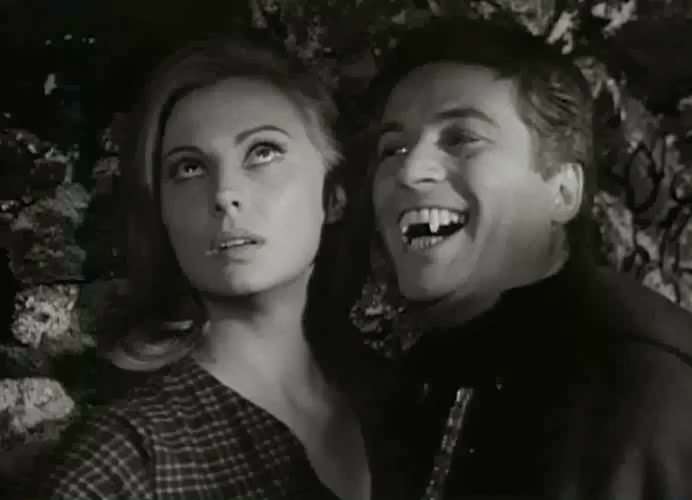
The word of the day is "vampires." I decided to check out this Italian shocker (filmed as L'Ultima Preda del Vampiro)...well, maybe shocker is a little strong. How about, "I decided to check out this Italian movie starring a bunch of hot chicks in diaphanous gowns, a creepy sort-of hero and a fairly ineffectual vampire."

The film opens with a shot of a hand emerging from a crypt and then cuts to a pair of hands running up a great set of gams (that's slang for "legs" for those of you who weren't alive in the 1940s). Which is pretty much all you need to know about the tone. The entire movie shifts between mild horror and mild T&A.

A group of showgirls, their manager Lucas (Alfredo Rizzo) and driver/pianist/general flunky Frank (Leonardo Botta) are traveling through a generic European setting by bus. They are short of money and have just fled from their last hotel without paying the bill. The road they are on is blocked by a landslide, so they take a side-road - never a good idea - and find the Castle Kernassy. They head inside, looking for shelter and find Count Gabor Kernassy (Walter Brandi). He grudgingly welcomes them to stay, warns them to obey his rules and not stray from the guest rooms and then disappears. One of the dancers, Vera (the fetching Lyne Rocco), resembles a long-dead ancestor of the Count. Even in 1960, this was a pretty hackneyed plot device. She does spend much of the movie walking around in a transparent nightie, however, so it balances out.


Vera seems to be missing the point...or should I say, points).
On the first night, one of the dancers - Katia (Maria Giovannini) ignores the Count's orders, wanders off into the castle and winds up dead. Her death is explained away as an accident, a fall from one of the castle windows. She is buried on the grounds of the castle. The Count convinces the troupe to stay, saying the only bridge has been washed out. This provides an opportunity for the girls to prance around in lingerie and engage in some cheesy dance numbers, including a pretty awesome striptease by Erika Di Centa.


Katia demonstrates the benefits of good oral hygiene
Vera confronts the Count underneath the painting of the Count;s ancestor who looks like her. Both express a mutual attraction, as well as a belief that they were meant to meet. While out for a walk that night, Vera discovers that Katia's body has been dug up. She thinks she sees the Count skulking about, but he flees when she calls to him. The next day, she discovers a laboratory - complete with smoke belching beakers and a human skull on a desk. She also finds Katia's body laid out on a slab. The Count shows up and spouts a lot of confusing nonsense, by way of explanation. He says he working to fight against some ancient evil and that Katia may have been murdered although by whom he won't say. Vera, not the brightest bulb and infatuated, is satisfied with his non-answer.


Katia discovers just how high the stakes are. Ouch...sorry...
There is a vampire lurking about, an ancestor of the Count who looks just like him. Like the Count, the vampire is infatuated with Vera, who resembles his dead wife. Katia comes back from the dead, Vera is attacked by the vampire, the Count tries to help and is knocked out. Katia, walking around naked (she provides the only clear nudity in the movie, a brief topless shot) but shrouded in shadow, is not happy about being replaced by a vampire Vera. Katia tries to attack the unconscious Vera is killed by vampire Count in a surprisingly gruesome (for the time) scene. The Count confronts his undead ancestor, telling him that he has developed a means to end the vampire's endless existence. The vampire tells him to get bent, that he likes being immortal. Fighting ensues and the Count manages to dispatch the vampire and rescue Vera. You might think that's the end. nope; there's still a ton of exposition, giving background information that is no longer important. In fact, the conclusion feels like padding. The menace is dead; I don't need 10 minutes of backstory and a long goodbye sequence between Vera and the Count. Finally, Vera leaves on the bus to resume her exciting life as a penniless showgirl and a voice-over informs us that the Count s going to sell the castle and find her. The end.


Erika Di Centa showing us why she's in the movie.
There are some serious story problems, particularly the tonal shifts from fairly moody scenes dealing with the horror plot to weak humor and cheesecake shots. The final confrontation between the Count and the vampire isn't very exciting (with the exception of Katiea's staking with a burning torch). And the experiments being carried out by the Count are never adequately explained. Is he trying to cure vampirism or just kill his ancestor? The point that Vera looks like the dead wife of the vampire is made repeatedly; but how this happened or why Vera acts at times like she has been to the castle, is never explained.

However, there are a lot of fun parts to the movie. It is shot in full on Gothic style complete with an imposing castle, a dank dungeon with crypts, and rainless thunder-storms. Brandi is good in the dual role of hero and menace. The female cast members are quite attractive and appear in various states of undress which was the main selling point of the movie. The dialogue is serviceable, although full of awkward lines. The black and white photography gives the film a nice, moody feel. While the film shows its low budget (Frank goes off to check on the bridge, finds it actually is washed out, discovers a village and talks to the villagers about the castle...all of camera) but the castle interiors are a mix of pretty good (some of the scenes were filmed at an actual castle) and pretty awful. The dungeon set, is especially bad, looking painfully fake. There are some nice shot compositions and a few moments of effective horror.

Taken for what it is - a mix of horror genre cliches and excuses for attractive women to walk around in skimpy outfits - The Playgirls and the Vampire is a fun movie. Check it out.

Thursday, October 24, 2013

31 Days of Halloween (Day 24) - American Mary

Wow. That was my first thought when American Mary ended. While not a perfect film, it is still a great, creepy, disturbing movie. It is well acted, has a engrossing and mostly satisfying story. It looks gorgeous. I was going to write "considering it is a low-budget movie"...but forget that. It just looks gorgeous.


Mary, the hottest medical wackjob ever.
The film follows Mary Mason (the beautiful and talented Katharine Isabelle, who is critical to the success of the film), a medical student who is running out of money. When she losses her low-wage waitress job, she heads to a local strip club, hoping to earn enough to stay in school and realize her goal of becoming a surgeon. While there, she is offered $5000 dollars by club owner - and brutal, but charismatic thug - Billy (Antonio Cupo) to provide some life-saving medical aid to a man he and his underlings were torturing. She is soon drawn into an underground world of body modification enthusiasts, including Ruby Realgirl (Paula Lindberg), woman who wants to become a living Barbie doll, complete with no nipples and a mostly closed vagina. While Mary shows reluctance, she also needs the money. As the film progresses, she is drugged and assaulted by one of her med school professors (Dr. Grant, played by David Lovgren) at a surreal rape party held by some of the local surgeons, which ends her career as a student. She uses her underworld contact with Billy - who is obviously in lust with her - to have Grant kidnapped and brought where she spends a couple of days trying out various body modification surgeries on him (although we only see the results later in the film). Mary becomes a sensation in the body modification community. She also becomes increasingly unstable. When we finally see what she has done to Grant - removed his arms and legs and keeping him suspended from chains in a storage locker - she winds up murdering a guard who discovers them. A short time later, she threatens one of the strippers at Billy's club. Billy suggests the two of them just leave together, but she heads home instead. The film climaxes with Mary being contacted by Beatress (a woman surgically altered to look like Betty Boop, played by Tristan Risk), who has been beaten by Ruby's husband, who is not happy with her "dollification" and is now looking for Mary. She is attacked by the husband in her home and stabbed. She kills him and sews her wound shut, but dies from internal bleeding, to be found by the police the next day. The end.


The Soska twins, looking all creepy-sexy...which is my favorite kind of sexy.
First, the few things that didn't work. The film's climax didn't work, reflecting a weirdly moralistic punishment for Mary. In keeping with the twisted tone of the film - and with how charismatic Mary is - it would have been far more satisfying if she had survived, whether on her own or with Billy. And there is an extended cameo made by the sisters who wrote and directed the film, Jen and Sylvia Soska that is badly acted - they sport really bad fake German accents - and pretty pointless. Of course, it's their movie - and more power to them for a) making a film and b) making a great film - but this scene drags. And that's really it.

The good...well, everything else. The film looks amazing. It is a beautifully shot film and shows how much talent can trump budget. The acting is great and care is taken to give even minor characters traits that set them apart. The film does have some gruesome moments, but nothing feels gratuitous and the effects are well executed and believable. The story proceeds logically, has enough tension to keep the viewer engaged and has protagonists (Mary and Billy) who change and deepen during the course of the film. There are well-timed moments of humor. In particular, I thought the scene where Mary, after having become a fixture in the extreme body modification community, almost has some poser who just wants a piercing beaten up, is hilarious. Since this is a horror film, there are some very cringe-worthy moments (when she is preparing to mutilate Grant and when she is getting ready to threaten the stripper) that remind you that, yes, this is a disturbing film. And the assault on Mary is distressing and necessary; unlike some films where there is a rape scene, this does not feel gratuitous. Oh, and Katherine Isabelle is amazing as Mary. She is able to convey the conflicted nature of the character and her descent into cold brutality, and possibly madness, quite effectively.

This is a movie that anyone who likes horror films, movies that focus on character psychology, thrillers...basically, anyone who likes a movie that is a little more challenging than the mindless multi-plex fodder of the day...needs to see. It is not perfect; but it is an impressive, gripping film.


Mary...great surgeon, but I'm not to keen on her dental techniques.

31 Days of Halloween (Day 23) - World of the Dead: The Zombie Diaries 2 (2011)

I haven't seen the original film, but I heard some good things about it. When the sequel popped up on Netflix, I decided "what the heck, I have 90 minutes to kill." And kill them I did. Slowly and painfully. Each minute was chained to a wooden table and I went to town on it with power tools. My minutes screamed for mercy (don't they always) but I was merciless. I was going to watch this movie to the bitter end.

The Zombie Diaries 2 is a found footage film. I am not dismissive of the sub-genre, particularly since I include mockumentaries (I consider them closely related). Movies like The Blair Witch Project, This is Spinal Tap, [Rec] and Punishment Park use the format to great advantage, giving the illusion of immediacy and a heightened sense of reality, even in unreal situations. Zombie Diaries 2 is not in the same ballpark as these movies. It's not even playing the same game.

Set a few months after a zombie-spawning virus has spread across the world, the story centers on a small group of soldiers and a single civilian who are making their way across England, in the hope of finding transportation to the imagined safety of mainland Europe. Along the way, they encounter a depraved group of survivors who are marauding across the countryside, as well as groups of zombies, hungry for human flesh. Added urgency is provided when the commanding officer of the group tells them that England is going to be subjected to a sustained bombardment, as it is the worst hit area in Europe. When the handful of survivors make it to a coastal base, they find that the base is deserted...except for the zombies of course. One man makes it out and encounters a pair of refugees from the mainland who tell him that things are no better there. The end.

As far as a concept for a zombie story goes, this isn't bad. As I was watching it, I could imagine how this would play out on the page and how it might read as coherent and worthwhile. Unfortunately for the filmmakers, the potential of the story is not translated to the screen. This film is a complete disaster, an exercise in lazy film-making.

I'll leave aside that it looks cheap. It is a low-budget movie after all. The make-up effects are okay, no worse than many other low-budget horror films out there. They look pretty bad compared to The Walking Dead; but not to the point where they detract from the film. Also, the last 90 seconds, where the film breaks out of the "found footage" format actually looks good and creates an appropriately bleak conclusion. That's where the good stuff ends.

Plotholes, abound, the most egregious of which takes place in the first five minutes. The film begins in a secure military base. However, the filmmakers wanted to kill off most of the characters and get the survivors on the move. Okay, that's a fairly standard film trope, one that I don't have a problem with. It is the way it is executed in this movie that makes no sense. One night, the main gate is left open. Why? How? That is never explained. It is such an obvious and non-nonsensical plot device, that it makes one wonder if the filmmakers have contempt for their audience.

It gets worse. The problem with found footage films is that you need an excuse for the camera man to keep filming when a normal person would stop and do something else. This movie fails miserable in this regard. We do know why the cameraman is making a film; he is a military videographer stationed at the base, creating a record for posterity. That makes sense; the problem arises as the story unfolds. The cameraman, an armed soldier, keeps filming even when his comrades are being torn apart. This makes no sense. Even worse, at no point does anyone bring this up. In some movies in this sub-genre, there is at least a moment when the filmmakers acknowledge the artificiality of the artistic conceit ("Why don't you put that camera down?" "Someone has to document the zombie/giant monster/angry broccoli attack."). It may make no sense; but at least there is the attempt. In The Zombie Diaries2 we get nothing. There are easy - and obvious - fixes for this. Here's one for free; don't make him a soldier. Just make him a civilian, someone who has never handled a gun in his life, someone who uses the camera as his defense/distancing mechanism. In Zombie Diaries 2, you get the feeling that the filmmakers were just too lazy to bother coming up with a rationale.

The story also treats us to an unpleasant and stereotyped rape scene. Sexual assault in a movie can be a powerful and appropriate moment. Think of Deliverance and Irreversible; in those cases the sexual assault is integral to the story. No matter how graphic it is, the viewer understands the story-driven reason for why it is happening. Here, it seems like an excuse to show some violence against a woman, show some tits, indulge in the stereotype of the "simple-minded boy being made a man" by having sex and make the villains more reprehensible in one of the easiest ways possible. It's not even the ugliness of the scene that it is a problem...it's just so dumb and pointless that it feels like filler.

The editing of the film makes little sense. Most of the story is shown in a linear fashion, with the camera showing the events leading from the base to the coast (the rape is filmed by the attackers who have taken the soldiers captive). Intercut with this linear film are scenes from a massacre of civilians the soldiers participated in before the movie begins. Why are these scenes there? I understand why they are there for the story; what doesn't make sense is why they are interspersed with the movie that is being filmed. The cameraman would literally have to be editing in the "flashback" scenes. That makes no sense at all.

Also, who is the audience? Since the cameraman is killed, the camera lost amongst a horde of the undead and England is, apparently, being bombed out of existence, who is watching the movie? Most films in this genre - at least the good ones - have a plot point indicating the audience. In Blair Witch, the film is discovered in the woods; in Cloverfield, the digital camera is discovered in the ruins of New York; with Diary of the Dead, the film is created and released on the Internet. Here...nothing.

If this movie had been filmed conventionally (not as found footage) the story might have been interesting enough to make the film worthwhile. If the found footage aspect had been handled more logically - say the cameraman is being sent out with a squad of soldiers to recon some critical facility (even sticking with the evacuation premise) and is transmitting the images back to a central base - then that conceit could have worked. As it is The Zombie Diaries 2 is an example of lazy, sloppy film-making and should be watched as a good example of how not to make a movie.

Wednesday, October 23, 2013

31 Days of Halloween (Day 22) - Maniac (2012)

The original Maniac is a low budget classic of the slasher genre. Made in 1980, the film is grim and gritty; so much so that you might want to take a shower after watching it. Staring Joe Spinell as Frank Zito - the titular maniac - a middle aged, hairy, greasy serial killer, who scalps women and attaches their hair to manikins in order to create surrogate mothers. If you haven't seen it, do so. It creates an image of New York City as part hunting ground/part open sewer, a city on the verge of imploding, with nightmare characters like Spinell being the only logical inhabitants.

When I read (in Rue Morgue, a fine horror publication also available on the iPad, which is how I read it) about a remake with Eljah Wood as Frank, I had some doubts. Although Elijah can play a good killer (he was one of the best things about Sin City, as the silent, almost superhuman Kevin) I wondered if he could fill Spinell's blood-covered shoes. It turns out he isn’t the problem, although he is lacking Spinell’s brutishness, something that worked in Spinell’s favor since you readily believe he could overpower his victims. Rather, the problems stem from how the story is told visually and from the point-of-view that the audience has.

The film (which has same basic story as the original - bad mom, kill women, scalps on manikins - the only real change being that Frank runs a manikin restoration business) is told subjectively, through Frank's eyes. Well, mostly through his eyes; there a few moments when the movie breaks this point-of-view, not all of which make sense. The strength of this narrative choice is that we get to see how bizarre his world is, with regular hallucinations and vision distorting migraines. It is certainly an interesting narrative choice. However, the subjective view doesn't add anything to the film, coming across as a gimmick. Since we don't have other points-of-view, we are being forced to adopt the role of the killer, perhaps even to understand and sympathize with him. The problem is that Frank's story isn't that interesting or original. He saw his mother turning tricks and now brutally murders women in order to create surrogate moms whom he can control. All of which is fine, as motivation for a killer; but it is nothing to sympathize with. Since we only see his victims through his eyes, we have less sympathy for them than we otherwise would. Subjective film making is a long tradition in slasher films. It was used to good effect in the original Halloween, for example; however, has always been used sparingly and for good reason. The killer is the threat, not the person the audience should be sympathetic too or identity with. There are exceptions to this general rule. In Psycho Norman Bates does have sympathetic qualities, particularly since when he kills, he is no longer Norman, he is "Mother." However, even if you can sympathize with aspects of the killer, you still identify with the victims.


Frank and his bride-to-bleed (with apologies to Forry Ackerman).
The other problem - and this may seem an unfair criticism, since it is a direct comparison with the original - is that the modern setting is not visually interesting. While the film is certainly polished looking, it lacks the "urban nightmare" quality of the original. Director Franck Khalfoun and cinematographer Maxime Alexandre know how to get a good shot. However, post-millennial Los Angeles is not as visually unique or tonally rich as NYC at the height of its late-20th century urban decay. It is the look of the original, the way in which the the dark, garbage strewn streets of New York become a character in their own right, that help set it apart from many of its contemporaries. In the original, the city reflects the killer; in the remake, the cityscape is generic.

There are some nice touches in the remake. The gore effects are plentiful and graphic, although nothing approaches Tom Savini's work, particularly the shotgun decapitation effect he created. However, it is refreshing to see that this is not a PG-13 movie. Blood and boobs are plentiful. There is also a funny shout out to Silence of the Lambs, with the song "Goodbye Horses" by Q Lazzarus, which was used during Buffalo Bill's "mangina dance," features in one of Frank's kills. And, I also find it amusing that Frank is constantly having to battle flies in his apartment, due to all the bloody scalps.

There are some scenes that play much worse, however. The low point is probably the "subway kill." In the original, a nurse returning home from work is stalked by Zito. She flees into a subway restroom, thinks she has avoided him, but winds up being run through by a knife. It is a truly frightening sequence. In the remake, Frank follows a dancer through a mostly depopulated Los Angeles subway system, chases her outside through completely deserted streets and traps her in a fenced-in parking lot. He then kills her in a brutal stabbing sequence. The problem: the victim clearly has a cell phone. She is seen fiddling with it in the subway. Why doesn't she just call the police? As the sequence of scenes plays out, she has at least one opportunity to do so. While this is a problem many modern horror films have to deal with there is no attempt to offer an explanation, even a bad one. It is a moment that took me completely out of the movie. Suspension of disbelief is something horror films usually demand; and, as a lover of the genre, I have no problem doing that. However, a filmmaker has to offer some rationale for a conceit like this, so as a viewer I can say "okay, that might be far fetched, but I can buy it for the purpose of watching and enjoying the film."

Like many remakes, Maniac 2012 leaves one asking "why?" Not all remakes are bad: in the horror and sci-fi genres, Carpenter's The Thing and Snyder's Dawn of the Dead are examples of worthwhile remakes, offering something new to the story told in the original. Unfortunately, Maniac doesn't have much to offer, once you get past the subjective point-of-view. And that, as I explained, doesn't work for me. I would still recommend checking it out; it is competently made, so you might enjoy it, particularly if you have not seen the original. For those who are fans of the original...I think you'll agree, there is no substitute for Joe Spinell.

Thursday, October 17, 2013

31 Days of Halloween (Day 17) - The Hills Have Eyes 2 (2007)

I decided to check out a sequel to a movie that is already part of my 31 Days series, The Hills Have Eyes 2. With Hills 2 we get to revisit everyone’s favorite radioactive mutant cannibal clan and see what they’ve been up to since the first film’s bloodbath.

After the success of Alexandre Aja’s Hills (making around $70 million on a budget of $15 million) it was no surprise that a sequel was made. Released in 2007, Hills 2 is superficially different, but eventually becomes more of the same; freaky mutants, gruesome kills, mutant rape (why someone decided this should be a trademark of the films is beyond me), and people in way over their heads having to become savages to survive.

Set two years after the first film, Hills 2 opens with a mixed team of scientists and soldiers setting up remote sensors after the Army has conducted “search and destroy” operations in the area to clean up the mutant menace. They missed a few and the mutants attack, wiping out most of the team. We are then introduced to our protagonists, a group of National Guardsmen conducting training exercises who are detoured to drop off some gear to the scientists. The characters are all stereotypes: the peacenik, the Rambo-wannabe, the big dumb guy...we’ve seen them in a thousand movies and will see them in a thousand more.

In short order, they find their long-range radios don’t work, they split up with most of the squad going to rescue a lone survivor and their only vehicle is destroyed. The survivor, Colonel Redding (Jeff Kober) lasts long enough to tell the Guardsmen what they are up against and how doomed they are, before taking his own life. Well, that’s one option. The mutants begin to attack and pick off squad members rapidly. The squad leader is taken out by friendly fire - we knew he had to die, because he was the only guy who knew what to do - but this isn’t a bad variation on how he’s killed. There’s the usual characters doing dumb things. For example, right after one of the mutants is killed, a female soldier - Missy (Daniella Alonso, whose defining characteristic is that she has a son) - wanders off to relieve herself and is promptly snatched. This, of course, makes no sense. It’s always a problem when a movie relies on characters doing obviously dumb things to move the story forward.

The survivors head into a series of mines that honeycomb the area to rescue Missy and to try to find a way down the mountain they are stuck on. More soldiers and mutants are killed off and Missy is subjected a brutal rape by the head of the mutant clan. She is rescued, the mutant patriarch is killed and our heroes emerge from the mines. There is a cut back to the science camp where a mutant is using the sensors to monitor the movements of the survivors, presumably leading to their demise. The End.

Hills 2 is not bad, once you get past the stereotypical characters and some serious leaps in logic that are used in place of more sophisticated storytelling. The mutants have even less personality than those in the first movie. Also there are just some really dumb scenes. A good example is the death of Colonel Redding. When the squad finds him, he is torn to shreds, wedged between some rocks and barely alive. He then somehow manages to get up, walk past them, go to the edge of a cliff, give a little speech and then shoot himself. Given how the scene is blocked, this makes no sense spatially. However, the pace is so fast that it would be easy for the viewer to just gloss over the holes in the plot.

On the plus side, the mutant makeup is well done. The gore effects are graphic and creative. There pacing is quick and doesn’t slow down for the entire movie. The direction is competent. In general, you know what’s happening in the fight scenes and the director gets the most out of the mountainous terrain. The film suffers a bit from the third act being entirely in the mines. While it does create a dark and sinister wonderland for the mutants to stalk their prey, it gives the film a cheap, set-bound feel.

The biggest problem I have with this movie is the missed opportunity. A more interesting alternative would have been to show use the Army’s “search and destroy” mission, perhaps even crafting a story in which some of our sympathy would lie with the mutants. Given that they are trying to survive as best they can in a hostile environment and that we are told they were hunted down by the government, this approach could have taken the clash between mutant and normal family and turned of the first film and turned it on its head. Instead, we get a very “by-the-numbers” splatter flick. An entertaining one, for those who like this horror sub-genre; but nothing memorable.

If you’ve seen Aja’s film and liked it, I’d say check this one out. It’s definitely inferior to the original, but it does have enough twisted mutant fun and blood and brain splattering kills to keep you occupied for 97 minutes.